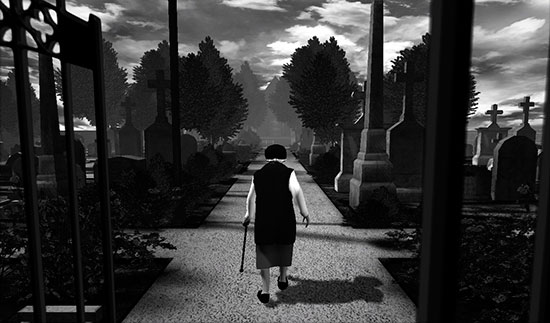
The Graveyard is a very short computer game designed by Auriea Harvey and Michaël Samyn. You play an old lady who visits a graveyard. You walk around, sit on a bench and listen to a song. It's more like an explorable painting than an actual game. An experiment with realtime poetry, with storytelling without words.
[...]
The full version of the game is exactly the same as the trial, except, every time you play she may die.
Samstag, 28. November 2009
The Graveyard
Freitag, 20. November 2009
Interessanter Blog
"Ours is a group blog, founded in May 2003, about computer mediated and computer generated works of many forms: interactive fiction, net.art, electronic poetry, interactive drama, hypertext fiction, computer games of all sorts, shared virtual environments, and more. Until May 2009 run as a centralized blog — with authors Andrew Stern, Mary Flanagan, Michael Mateas, Nick Montfort, Noah Wardrip-Fruin, and Scott Rettberg — GTxA is now an aggregator for a distributed group of blogs in which we participate. The authors of these blogs work as both theorists and developers, and are interested in authorship, design, and technology, as well as issues of interaction and reception."
Sonntag, 25. Oktober 2009
Hamlet Hypertext
Zitat Tina: "Die Filme sind reichlich seltsam - die Animationen haben etwas von SouthPark und man kann im Stil von PackMan Hamlet gegen Laertes kämpfen lassen. Der Grund weshalb ich den Link schicke ist der eine Animationsdings - der letzte mit dem kleinen, dicken Hamlet. Da kann man mitten drin immer "interaktiv" bestimmen wie es weitergehen soll - macht zwar alles keinen Sinn, aber vielleicht freut es Bode :-) all open-ending...or so..."
Escapist zu "Make Your Own Fun"
Samstag, 8. August 2009
Second Skin - 1,5 Stunden über MMORPGs
Dienstag, 4. August 2009
Interaktiven Spielbücher
Sonntag, 19. Juli 2009
Sonntag, 5. Juli 2009
Und gleich noch einer
...kennt ihr bestimmt eh, oder?
ARTE: Durch die Nacht mit...
...Chris Crawford, 58, legendärer Computerspieldesigner und scharfer Kritiker der heutigen Game-Industrie, trifft bei der Game Developers Conference in San Francisco auf Wunderkind Jason Rohrer, 31, der mit seinen metaphorischen Computerspielen innovative Wege verfolgt.
Bei Arte - noch etwa eine Woche anzusehen. Interessant. Der Typ hat auch On Interactive Storytelling geschrieben.
Mittwoch, 10. Juni 2009
Guillermo del Toro über die Zukunft des Geschichtenerzählens
Discuss...del Toro: In the next 10 years, we’re going to see all the forms of entertainment—film, television, video, games, and print—melding into a single-platform “story engine.” The Model T of this new platform is the PS3. The moment you connect creative output with a public story engine, a narrative can continue over a period of months or years. It’s going to rewrite the rules of fiction.
Wired: It sounds like you’re talking about an entirely new form of storytelling.
del Toro: Think about the way oral tradition became written word—how what we know about Achilles was written many, many years after it made its way around the world with different names and different types of heroes. That can happen when you allow content to keep propagating itself through different kinds of platforms and engines—when you permit it to be retold with a promiscuous form of mythology. You see it when people create their own avatars in games and transfigure their game worlds.
Sonntag, 7. Juni 2009
Auch wieder knapp am Thema vorbei...
Edit: hier gibts eine ganz gute Online-Review zu NAWLZ: http://webcomicoverlook.com/2009/01/14/the-webcomic-overlook-64-nawlz/
Dienstag, 26. Mai 2009
Richard Bartle on - boring stuff.
Zumindest ein Zitat, bei dem ich den Gedanken ganz interessant und ansatzweise relevant finde:
gguillotte: I've been watching procedurally generated content for a while. Love comes to mind, a PG MMO. What sort of impact is this going to have, where content generation is automated?
Richard: it depends if the generation of the content is the game or is filler
Richard: procedural content can work - I've spent many, many hours playing Rogue for example
Richard: using procedural content to create a canvas for virtual worlds seems a perfectly rational thing to do
Richard: however, the designer has to put their soul in it somewhere: either this is by modifying the procedural content or by creating the framework that creates it
Richard: now the former is the traditional way for designers to speak to players; if a designer wants to speak through the content-generation rules, well
Richard: that would be possible but we don't have the vocabulary for it yet
Anyway, zumindest war das ein Vorwand, auch mal auf den Bartle Test zu verweisen und auf Terra Nova. Und wenn ich schon dabei bin: Sehr empfehlenswert für Grundlagen von Game Develop-Seite ist der Escapist.